The Environmental Impact of AI
Commentary by Ariel Warren. Photo courtesy of IMD Business School.
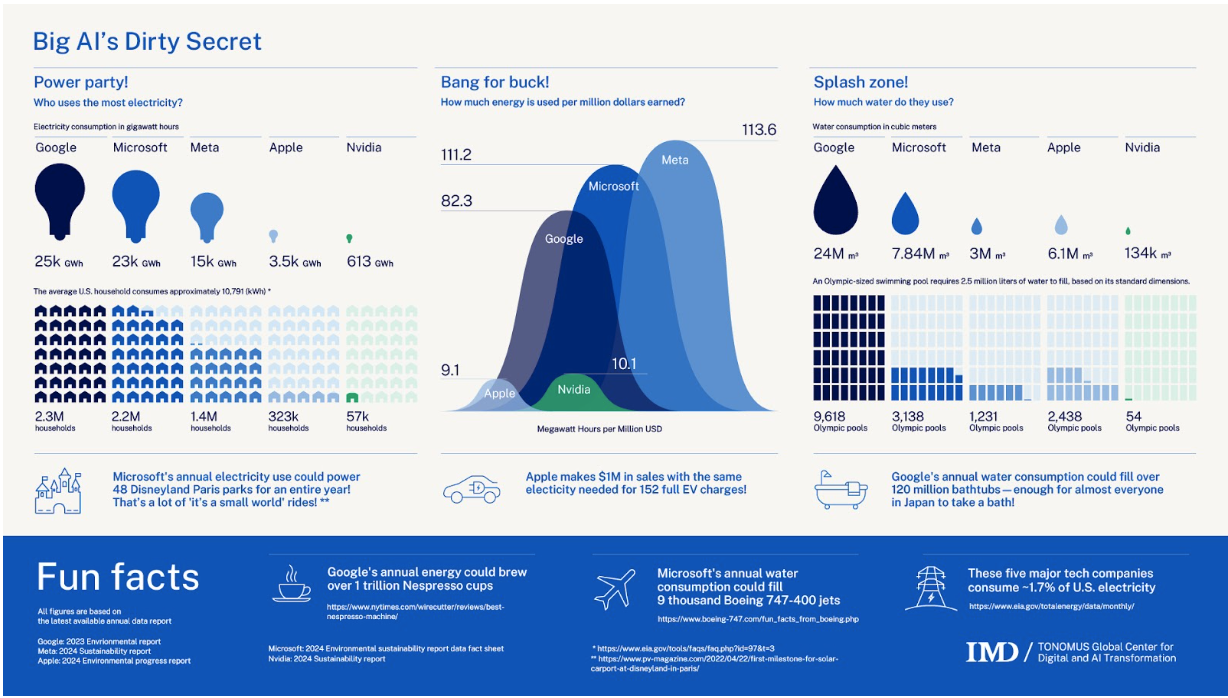
Companies based in the U.S. like Meta, Google, Microsoft, Apple, and Nvidia have been using AI since the 2010’s to help power their core products. AI has been a developing idea since the 1950’s. Using AI has become a popular trend with tech companies because of the lower costs - AI can’t ask for a raise or quit like a human employee can. As a result of the increasing use of AI, it’s now slowly killing the earth and its people.
AI uses the earth’s water, electricity, and air in order to function. According to the UN Environmental Programme's article AI has an environmental problem. Here’s what the world can do about that, “the proliferating data centres that house AI servers produce electronic waste. They are large consumers of water, which is becoming scarce in many places. They rely on critical minerals and rare elements, which are often mined unsustainably. And they use massive amounts of electricity, spurring the emission of planet-warming greenhouse gases.” Here, it’s clear that AI is using the earth’s natural resources at an alarming and unethical rate. Eventually, the rising environmental crises will start to affect people too. However, it won’t affect those who are profiting and benefiting off of AI. It’ll affect the ordinary citizens that are using it.
If the use of AI does not become limited or stopped completely, low income families will be impacted by it the most. Low-income families will experience a lack of free clean drinking water, an increase of electricity bills, and an increase in disease because of air and water pollution. Luckily, it’s never too late to stop using AI in order to save our environments and our communities.
Ariel Warren is a senior at Friendship Collegiate Academy.